
 Home
 JCT
 Nov 19,2026

What Is the Difference Between a Resin Reactor and a Mixing Tank?
A resin reactor is a vessel designed for a chemical reaction — resin synthesis or base preparation — with heating, vacuum, condensation and separation equipment built around the process. A mixing tank is designed to blend components that are already made. The difference is not the shell; it is what happens inside and what is connected to it.
Why this question matters before you buy
Buyers often use "reactor" and "mixing tank" interchangeably, because from the outside both are a cylindrical vessel with an agitator on top. The price gap and the process gap, however, are large. Specify a mixing tank for a job that needs synthesis, and the vessel will never perform the reaction. Specify a reactor for simple blending, and you pay for hardware you will not use.
The right way to separate them is to ask one question: are you making a new substance, or blending substances you already have? Your answer determines the configuration.
The core difference: reaction versus blending
In JCT's own product mapping, the chemical reactor is listed for "resin synthesis and base preparation," serving resin, water-based adhesive and silicone oil lines. The mixing and dispersion machines are listed separately, each with its own job:
| Equipment | Stated purpose |
|---|---|
| Chemical reactor | Resin synthesis, base preparation |
| Horizontal kneader | High-viscosity kneading |
| Vertical kneader | Ultra-high-viscosity, high-purity material |
| Dual planetary power mixer | High-solids slurry mixing |
| High-speed disperser | Pigment and powder dispersion |
| Ribbon blender | Powder mixing |
So in a JCT context, "mixing tank" is a generic term rather than a single product line — it maps to several machines, each selected by viscosity and material behaviour. A reactor is a distinct category with a distinct job.
What a resin reactor actually includes
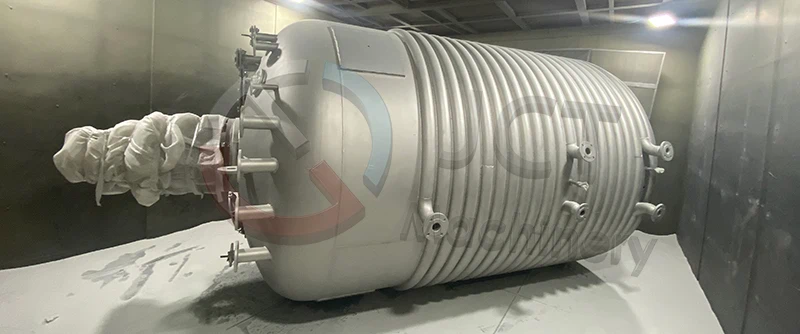
A reactor is defined by the process equipment attached to it, not by its agitator. Look at a real 200L epoxy resin line: alongside the reactor it includes a dephlegmator, a horizontal condenser, a 30L water knockout vessel, vacuum pump and vacuum tank, cooling tower, water pump, operating platform and the full set of material, cooling-water and vacuum lines. None of these appear on a simple mixing tank — they exist to control a reaction: condense vapours, remove water, hold vacuum and manage temperature.
A larger 4000L epoxy resin line makes the point even more clearly. Its equipment list includes a sodium hydroxide solution dropping tank and metering pump, a fractionation column, horizontal condenser, oil-water separator, epichlorohydrin collection tank, filter, settling tank, a benzene removal kettle, a second fractionation column, benzene collection tank, vacuum system, cooling system and a steam boiler. Dosing, fractionation, phase separation and solvent removal are reaction operations. A mixing tank has no reason to carry any of them.
Even a reactor built for a high-viscosity product rather than a synthesis — a 1300L hot-melt glue reactor — carries reaction-grade hardware: an anchor-frame agitator at 0–56 rpm, a single mechanical shaft seal, a jacket for heating, a water-ring vacuum pump with a 120L buffer tank, a heated three-screw discharge pump, temperature display and control, and an explosion-proof motor. The slow anchor speed is there to move a difficult material; the seal, vacuum and jacket are there to control the process environment.
How the two differ in practice
| Dimension | Resin reactor | Mixing tank / mixer |
|---|---|---|
| Primary job | Synthesis or base preparation | Blend existing components |
| Typical process | Dosing, heating, vacuum, condensation, phase separation | Agitation, dispersion, kneading |
| Vessel internals | Anchor, frame or pitched blade matched to reaction viscosity | Sigma blades, planetary agitator, dispersion disc, ribbon |
| Attached systems | Condenser, separator, vacuum buffer, cooling tower, often a steam source | Pump, filter, heating jacket as needed |
| Selection driver | Reaction chemistry and thermal control | Viscosity, solids content, dispersion requirement |
One practical note: a reactor can also mix. The 1300L machine above has a 0–56 rpm anchor agitator and mixes high-viscosity material well. The reverse is not true — a mixing machine does not become a reactor because it has a heater and a lid. If your process needs a chemical conversion, start with the reactor.
Choose by process, not by vessel shape
A few questions will separate the two quickly:
- Does the process create a new substance, or homogenize a ready formulation?
- Does it need dosing at a controlled rate, reflux, vacuum, or water removal?
- Are vapours or solvents generated that must be condensed or separated?
- Is the requirement high-viscosity kneading, high-solids mixing, or fine powder dispersion?
If the first three answers are yes, you are specifying a reactor. If the last one dominates, you are specifying one of the mixing machines — and the exact one depends on viscosity and material behaviour. JCT designs from a 3D process demonstration, with blade profile, torque, vacuum and temperature control matched to the actual material, and drawings within three days.
Both categories come from the same source factory
JCT Machinery was established in 2006 and is a source manufacturer, not a trading company. It builds reactors and mixing equipment in its own plant in Foshan, handling design, machining, welding, assembly and trial running in-house. The company holds 17 utility-model patents and 2 software copyrights, with ISO 9001 and ISO 14001 certification and CE marking, and has served more than 3,000 customers across seven export regions. Around 95% of orders involve customized production lines. Customers can run trials with their own material before ordering.
If a project needs both — synthesis in a reactor followed by mixing or dispersion downstream — JCT integrates them into one line, from feeding and reaction through dispersion, deaeration, discharge and packaging.
Tell us the process, and we will name the machine
Send your material, reaction or mixing step, viscosity and target batch size. We will tell you whether you need a chemical reactor or a mixing machine — and which configuration fits, rather than selling you a vessel by its shape.
JCT Machinery — source factory and turnkey partner for reactors, mixers and complete production lines. We don't just sell machines — we make your production line run.
 Alkyd Resin Production Line Turnkey Project: From Reactor to Finished Coating