
 Home
 JCT
 Nov 20,2026

Alkyd Resin Production Line Turnkey Project: From Reactor to Finished Coating
An alkyd resin line rarely fails at the reactor itself. More often it stalls at the seams — dosing that drifts between batches, a condensation step that never reaches target consistency on schedule, dilution that overheats the batch, a filter that cannot keep up with discharge, or a filling station waiting for the tank. For a coatings producer commissioning a new alkyd resin production line, these hand-offs decide whether the plant runs at design output or becomes a collection of expensive standalone machines. A turnkey alkyd resin plant removes that gap by treating metering, reaction, dilution, filtration and packing as one controlled sequence rather than five separate purchases.
What the global market asks of an alkyd resin plant
Alkyd resins remain a workhorse binder for architectural and industrial coatings, printing inks and corrosion protection. Demand is no longer only about volume: buyers ask for tighter batch-to-batch colour and viscosity consistency, lower solvent content, and the flexibility to run short batches of specialty grades alongside long runs of standard ones. Two practical constraints shape the alkyd resin manufacturing process in almost every market. First, utilities differ — steam, cooling water, chilled oil and available voltage vary from site to site, so heating and agitation must be specified against the actual plant, not a catalogue default. Second, solvent-bearing processes raise safety expectations; explosion-proof motors and appropriate sealing are specified where local rules require them. A line designed around those constraints from the start avoids costly rework after installation.
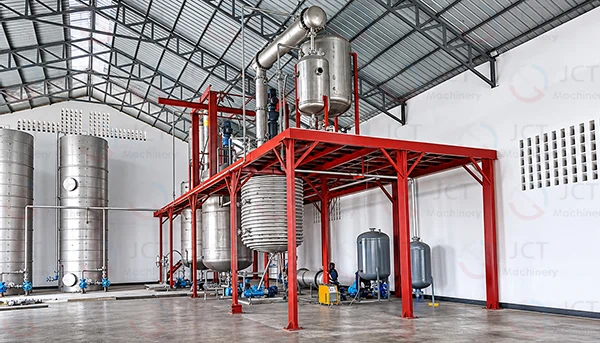
One partner from equipment to repeatable output
JCT is a source factory for high-viscosity mixing and reaction equipment, and a turnkey line integrator — we don't just sell machines, we make your production line run. For an alkyd resin production line, that means three layers of delivery.
Equipment. Reactors built to the process, with the agitator, heating arrangement and sealing chosen for the formulation rather than taken from a standard list.
Line. Feeding, reaction, dispersion, de-airing, discharge and packaging integrated and commissioned as one system — the scope a turnkey alkyd resin plant is judged on.
Repeatable capability. PLC control with recipe management and protected programmes, so a grade that runs correctly on Monday runs the same way next month, and can be reproduced when the line is scaled.
Because 95% of our orders are custom lines rather than standard machines, every customized resin line we deliver is engineered around the process — this integration is our normal work, not an exception. As a source manufacturer rather than a trading company, we carry the responsibility for the interfaces between machines.
Evidence behind the claim
Several facts make that position concrete. We have been building mixing and reaction equipment since 2006, from a 5,000 m² plant with a team of around 50. Our engineers have delivered more than 10 automated production lines, and we hold 17 utility model patents plus 2 software copyrights. Equipment spans 5-litre laboratory units to industrial machines above 10,000 litres, so a pilot grade can be developed and then scaled without changing supplier. Our quality and environmental management systems are certified to ISO 9001 and ISO 14001, and our equipment carries CE marking. We have served more than 3,000 customers, with exports to North America, Europe, Africa, Southeast Asia, the Middle East, the CIS and South America. For a buyer evaluating alkyd resin production line manufacturers, a source factory for resin lines offers this record less as a badge than as evidence that the hand-offs between machines have been solved many times before.
What the line actually contains
The reactor is the core
Alkyd resin synthesis is a batch reaction, so the reactor sets the pace. Our alkyd resin reactor is built as a complete reaction vessel, with body, transmission, agitation, sealing, heating and cooling arranged around the customer's process. Standard configurations cover 20 L to 80,000 L, working volume around 80–90%, operating temperature from -20 °C to 300 °C and pressure from vacuum (-0.1 MPa) to 1.6 MPa. Agitators are selected from inclined propeller, anchor, anchor-frame, helical ribbon, turbine, dispersing disc and combined types; sealing is mechanical or packing; and heat transfer is arranged through an outer jacket, outer half-pipe or internal coil. Materials include SS316, SS321, SS304, Q235-B carbon steel and enamel.
Supporting equipment and systems
A reactor alone does not make an alkyd resin plant. The line is completed with metering tanks, fractionating columns, condensers, water separators, collecting tanks and filters, together with heating, cooling, vacuum, nitrogen generation, feeding, discharge and packaging systems. Heat transfer oil circulation, jacket electric heating, steam heating and cold oil or cold water cooling can be matched to the utilities available on site. These are the components that turn alkyd resin synthesis equipment into a working line.
Automatic control
The process runs under PLC control: raw materials are metered, batched and conveyed automatically; reaction steps are set in advance, with temperature, pressure, reaction time and agitation speed controlled automatically; and the finished product is transferred to storage for automatic filling or packaging. This is what makes a custom alkyd resin production line repeatable rather than dependent on one operator.
Resin experience and compliance
Resin lines are not new territory for us. Our delivered projects include a polyester polyol production line for a customer in Pakistan — a neighbouring resin category that uses the same reactor-based synthesis and downstream handling logic as alkyd resin. We do not claim an alkyd-specific reference where we do not have one; we show the transferable part instead: reactor engineering, batch control and line integration. On the compliance side, our management systems are certified to ISO 9001 and ISO 14001, and the reactor and sigma mixer series carry CE marking. As an alkyd resin equipment supplier, we invite customers to the Foshan plant — with 3–5 days' notice so a trial run can be prepared.
Delivery and after-service support
Every project starts with a 3D process demonstration, and drawings are issued within three days of process confirmation. Standard machines ship in about 30 days; a custom alkyd resin line takes 30–60 days, with 7–15 extra days reserved for export packing and documentation. Each delivery includes installation, commissioning and operator training, plus 3 years of after-service support.
Start with your formulation, not a catalogue
Tell us the resin grade, batch size, target output and whether the process is solvent-based or water-borne, and we will come back with a configuration and a 3D process layout — not a generic brochure. If you are comparing alkyd resin production line manufacturers, the useful question is how each one handles the interfaces between dosing, reaction, filtration and filling.
Ready to scope your alkyd resin line? Send your formulation and target output to george820606@gmail.com or visit resinreactor.com.
 What Is the Difference Between a Resin Reactor and a Mixing Tank?