
 Home
Home JCT
JCT  Oct 20,2025
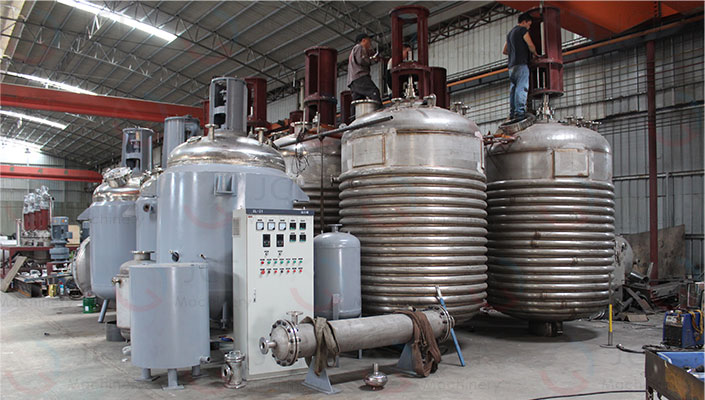
Resin Types Used in Reactor
Applicable conditions:
- Low viscosity (≤100,000cps)
- Solvent-based system or low-solids reaction
- Controllable exotherm and uniform temperature are sufficient.
Common Resin Types
| Resin types | Main equipment | Reason |
| Alkyd resin | Jacketed reactor (with condensation and dehydration devices) | The system contains a solvent, has good fluidity, and requires a continuous dehydration reaction |
| Acrylic resin | Stirred reactor | The reaction temperature is controllable, the viscosity is low, and solution polymerization or emulsion polymerization is often used |
| Epoxy resin | Jacketed reactor | The viscosity is moderate, requiring temperature control and vacuum degassing |
| Unsaturated polyester resin (UPR) | Electrically heated or thermal oil heated reactor | Medium-to-low viscosity systems require stable temperature control to avoid side reactions |
| Urea-formaldehyde / Melamine resin (UF/MF) | Stainless steel reactor | Aqueous systems with low viscosity require precise pH and temperature control |
**For resins with low viscosity, which require continuous heat exchange and precise temperature control, reactor is more suitable.
Resin Types Used in Sigma Mixer
Applicable conditions:
- High viscosity systems (≥100,000cps)
- Mid- to late-stage reaction materials are paste-like or semi-solid
- Vacuum dehydration, desolventization, and dealcoholization are required
- Solventless, high-solids or modified systems
Common Resin Types
| Resin types | Main equipment | Reason |
| Silicone resin | Sigma mixer | The late-stage viscosity is extremely high, requiring vacuum dealcoholization during polycondensation |
| Phenolic resin | Sigma mixer / reactor | Particularly for solid, powdered, or modified phenolic forms, strong shear mixing is required |
| Epoxy-modified resin | Double planetary mixer / sigma mixer | High viscosity and high filler content make traditional reactors difficult to stir |
| Polymide precursor | Sigma mixer | High-temperature polycondensation systems have extremely high viscosity, requiring a closed reaction system |
| Solvent-free polyurethane | Sigma mixer / double planetary mixer | The reaction is rapidly exothermic, resulting in high viscosity and requiring high shear dispersion |
| Solid epoxy resin | Sigma mixer | After cooling, the product solidifies into agglomerates, resulting in high viscosity and slow heat transfer |
**Sigma mixer is most suitable for resins with high viscosity, difficult to stir in the late reaction stage, requiring vacuum concentration or high shear.
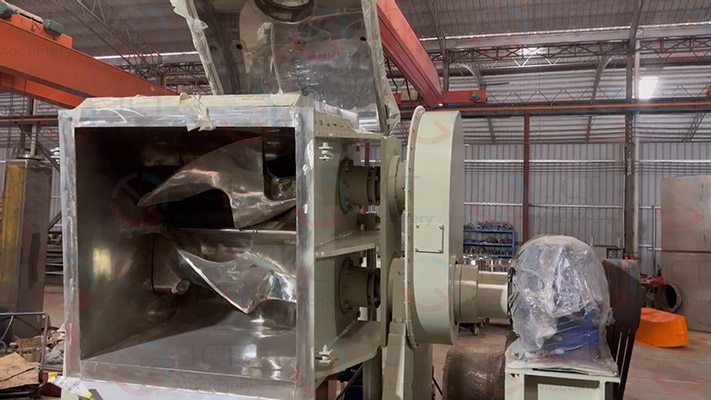
Some resins can be used in "reactor + sigma mixer" combination.
Some resins (such as silicone resin, phenolic resin and epoxy-modified resin) are produced using a two-stage process:
- Front-end reaction (low-viscosity stage) → initial polycondensation in the reactor.
- Mid- and late-stage (high-viscosity stage) → transfer to sigma mixer for further reaction and concentration.
This ensures a thorough reaction while avoiding the problem of the reactor becoming unstirable.
If you want to set up resin production line, feel free to chat with us: +86-181 3837 3963 (Whatsapp, Wechat) or george820606@gmail.com.
 The Role Of Reactor Sandblasting