
 Home
Home JCT
JCT  Oct 15,2025
What is acrylic resin?
Acrylic resin is a type of synthetic resin produced through free radical polymerization using acrylic acid, methacrylic acid, and their esters as primary monomers. It boasts high transparency, strong adhesion, excellent weather resistance, and high gloss, making it widely used in coatings, inks, adhesives, plastic modification, and automotive paints.
Acrylic Resin Production Line Equipment Configuration
| Equipment | Function |
| Reactor | Perform monomer polymerization reactions and control temperature and pressure. |
| Condenser | Condensate volatiles generated by the reaction and recover monomer and solvent. |
| Vacuum system | Remove gases and improve product purity. |
| Metering tank and dosing system | Precisely control the addition rates of monomer, initiator, and solvent. |
| Stirring system (with VFD control) | Ensure uniform mixing of materials and efficient heat transfer. |
| Storage tank and cooling tank | Store finished products and regulate their temperature. |
| Filtration system | Remove impurities and ensure product purity. |
| Automatic control system | Automatically control reaction temperature, stirring speed, and addition rate. |
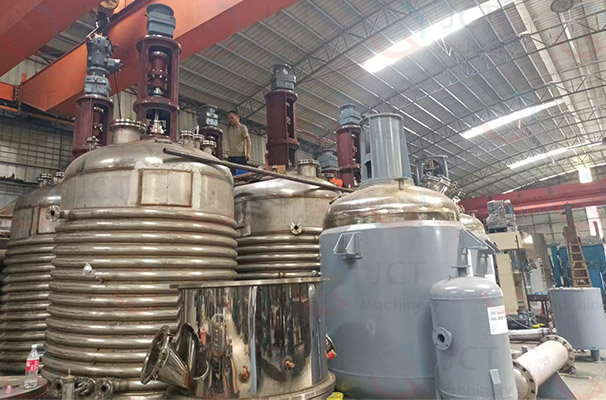
Why Choose JCT's Acrylic Resin Production Line Turnkey Project?
- Fully automated control – A PLC system monitors the reaction process in real time, reducing manual errors.
- Efficient heat transfer design – Reactors with external or internal coils offer more precise temperature control.
- Customizable formulation system – Different process routes are available based on the customer's product type (thermoplastic, thermosetting, solvent-based, water-based).
- Energy-saving and environmentally friendly – A condensate recovery system and exhaust gas treatment unit meet environmental standards.
- Turnkey project services – Comprehensive service from equipment design, manufacturing, installation, commissioning, to process formulation.
What should be considered when controlling the acrylic resin reaction process?
- Temperature Control: Polymerization is exothermic, requiring precise regulation of heating and cooling water flow rates to prevent temperature overshoot.
- Stirring Speed: This affects the polymerization rate and product viscosity and should be adjusted flexibly based on the resin type.
- Drip Rate: Monomer, initiator, and solvent must be added evenly to prevent overly rapid reactions and side reactions.
- Vacuum and Condensation Efficiency: Ensures that residual solvent in the system is effectively recovered, improving product quality.
JCT's acrylic resin reactor and acrylic resin production line turnkey project are your best choices!
Phone: +86-181 3837 3963 (Whatsapp, Wechat)
Email: george820606@gmail.com
 Reactor vs Sigma Mixer