
 Home
Home JCT
JCT  Mar 03,2026
1. What are the key processes in paint production line?
Raw material preparation
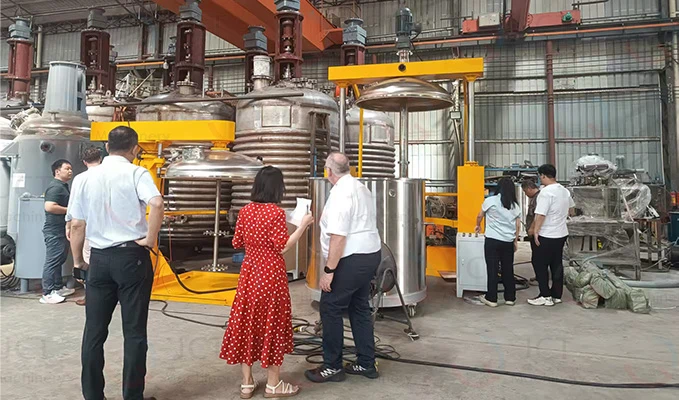
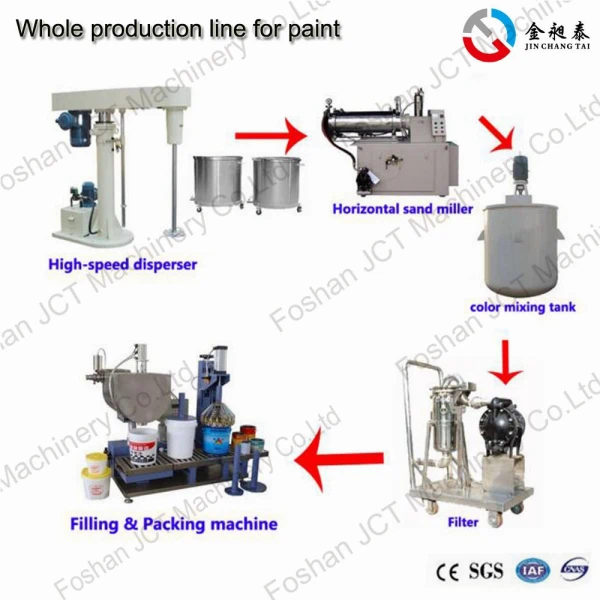
Preliminary dispersion: High speed disperser wets and coarsely disperses the powder.
Grinding and refining: Grinding equipment such as sand mills reduces the pigment particle size to the design standard.
Paint mixing: Adjusting the formula ratio and adding additives ensures consistent color and function.
Filtration and testing: Removing large particles and testing indicators such as viscosity and color difference.
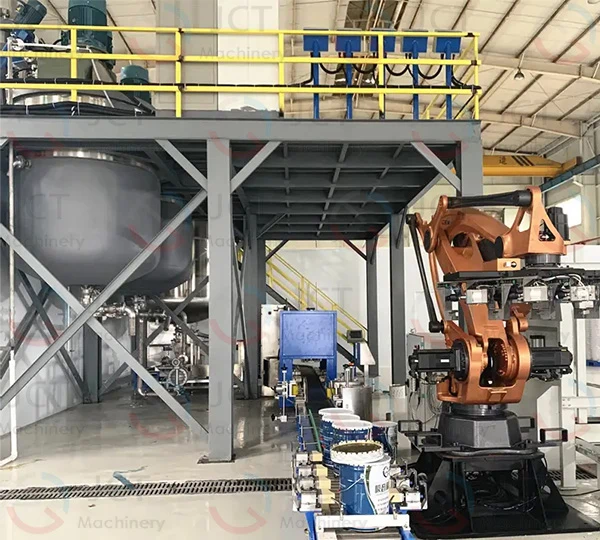
Filling and packaging: After filtration, the finished product is automatically filled, sealed, and shipped.
2. What are the common malfunctions in paint production line? How to solve them?
Clogged spraying equipment or unstable paint output: This is often caused by pigment sedimentation or impurities clogging the nozzles. Solutions include installing filters, daily nozzle cleaning, and standardizing paint mixing ratios.
Low production line efficiency and unreasonable layout: This may be due to a mismatch between the process cycle time and the equipment speed. It is recommended to optimize the workstation layout, conveyor system, and cycle time control.
Equipment malfunctions: Such as conveyor belt slippage or motor overload, can be avoided through regular maintenance, load monitoring, and replacement of aging parts.
Environmental and safety issues in production: It is necessary to have adequate waste gas treatment and fire protection systems to ensure process stability and compliance.
3. How to improve the efficiency and capacity of paint production line?
Equipment layout and process matching: Optimize the arrangement of equipment such as dispersion, grinding, mixing, and filtration to reduce logistics and operation time.
Operating procedures and personnel training: Standardized operations reduce human error.
Digital management system: Introduce MES/ERP systems to monitor production progress, color difference indicators, material status, and other data, improving production visibility and responsiveness.
Production cycle time optimization: For example, adopting batch production based on color series reduces changeover losses and improves overall cycle time efficiency.
4. What are the most common quality issues in paint production?
Common quality problems often stem from:
Inaccurate raw material ratios: Deviations in the resin-to-pigment ratio can result in substandard hiding power and adhesion.
Uneven grinding particle size: Incomplete pigment refinement leads to a rough paint film or insufficient hiding power.
Insufficient/over-mixing: Affects the gloss and leveling properties of the paint film.
Improper control of the spraying and drying process: Causes sagging, insufficient leveling, or incomplete curing.
5. Does paint production require attention to environmental protection and workplace safety?
Yes. Paint production and spraying processes typically generate VOCs (volatile organic compounds) and dust pollution.
A waste gas collection and treatment system is required to ensure emissions meet standards.
Explosion-proof and fire-prevention measures in the workshop must be strictly implemented.
Employees must wear PPE (protective equipment), and standardized safety operating procedures must be followed.
6. What services does JCT provide?
- Customized paint formulas according to customer requirements
- Providing complete paint production line solutions from R&D and pilot testing to large-scale production
- Supporting multiple systems (e.g., water-based, solvent-based, powder, etc.)
- Assisting with quality control, packaging design, and logistics support
Contact us for customized paint production line: +86-181 3837 3963 (WhatsApp, Wechat) or george820606@gmail.com.
 Specialty Epoxy Resin Production Line: A "Turnkey" End-to-end Solution—From Formula To Commerical Production