
 Home
Home JCT
JCT  Nov 20,2025
Phenolic resin is a widely used thermosetting resin with characteristics such as high temperature resistance, corrosion resistance, high mechanical strength, and good electrical insulation. It has stable demand in industries such as refractory materials, brake pads, abrasives, casting, adhesives, laminates and coatings.
Classification and production process differences of phenolic resin
Based on polycondensation type and application, phenolic resins are classified as follow:
1. Alcohol-soluble phenolic resin (Novolac)
- Acid-catalyzed system
- Usually requires hexamethylenetetramine as a curing agent
- Commonly used in: abrasives, braking materials, and refractory materials.
2. Thermosetting phenolic resin (Resol)
- Alkali-catalyzed system
- Contains formaldehyde groups and can be directly cross-linked and cured
- Commonly used in: adhesives, laminates, bakelite products, and casting resins.
Different types of resins have different requirements for reactor structure, temperature control methods, and condensation systems. Production lines should be customized according to the product application.
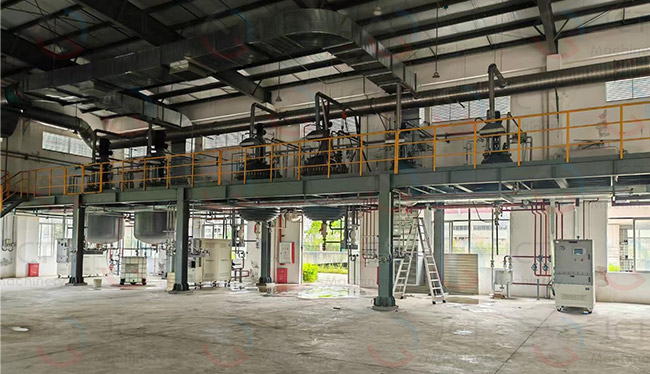
Phenolic Resin Production Line Equipment Configuration
1. Reactor
The polycondensation reaction of phenolic resins exothermic. The reactor typically uses:
- Stainless steel or carbon steel lined with non-stick material
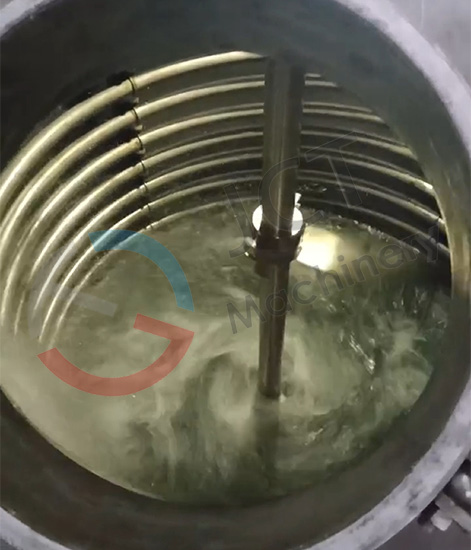
- Jacketed or coiled heating/cooling system
- Powerful stirring impellers (anchor type, frame type, combined type)
- Explosion-proof motor
- Vacuum and sealing system
2. Reflux and fractionation system
Used for controlling the reflux and dehydration of formaldehyde and moisture, ensuring stable reaction characteristics.
3. Vacuum dehydration system
Increases resin solids content, improves flowability and thermal stability.
4. Filtration system
Removes impurities, ensuring the purity and color of the finished product.
5. Storage tanks and finished product packaging system
- Hot storage tank insulation system
- Bottom discharge pump
- Liquid phenolic resin can be packaged in drums or tonnes
- Solid phenolic resin is produced by thin-film evaporation or cooling granulation
Phenolic Resin Production Process
- Heating reaction: Controlled polycondensation at 90-120℃.
- Reflux/friction: Adjusting free formaldehyde content.
- Vacuum dehydration: Increasing solids content.
- Blending: Adding plasticizers and stabilizers.
- Filtration and impurity removal
- Discharge adn packaging
Target Customer Groups
- Brake pad manufacturers
- Refractory material factories
- Abrasive wheel and sandpaper manufacturers
- Foundry resin factories
- Composite material manufacturers
- Adhesive manufacturers
Why choose JCT's phenolic resin production line turnkey project?
✔ Fully automated control
Ensuring precise control of reaction temperature, pressure and vacuum.
✔ Enhanced safety
Equipped with explosion-proof motors, negative pressure operation, and over-temperature alarms.
✔ Customized process combinations
Liquid phenolic resin, solid phenolic resin, adn modified phenolic resin can be designed according to customer needs.
✔ Energy saving and labor cost reduction
Multi-stage heat exchange design reduces energy consumption.
✔ Suitable for developing markets such as the Middle East, Southeast Asia, Russia and India
Reliable structure, easy operation and low maintenance costs.
 Why Is Now The Best Time To Invest In Acrylic Resin Production Line?