


| Equipment | Highlights |
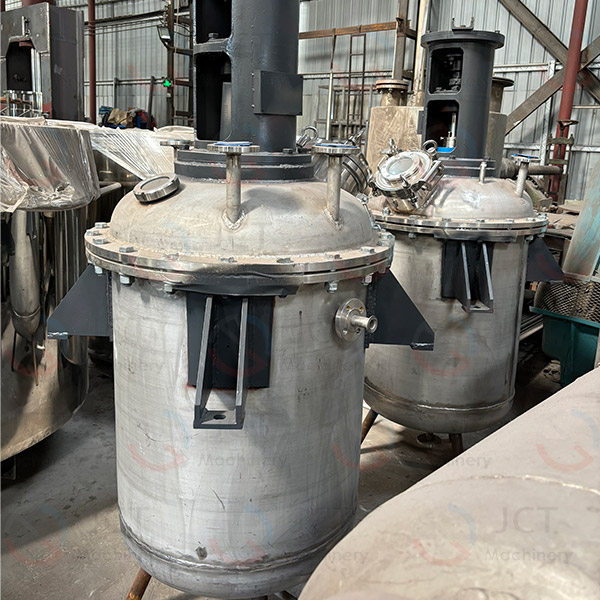
| Pre-emulsification reactor | Equipped with a high-speed disperser (1440rpm or higher) to ensure fine and uniform emulsion droplets |
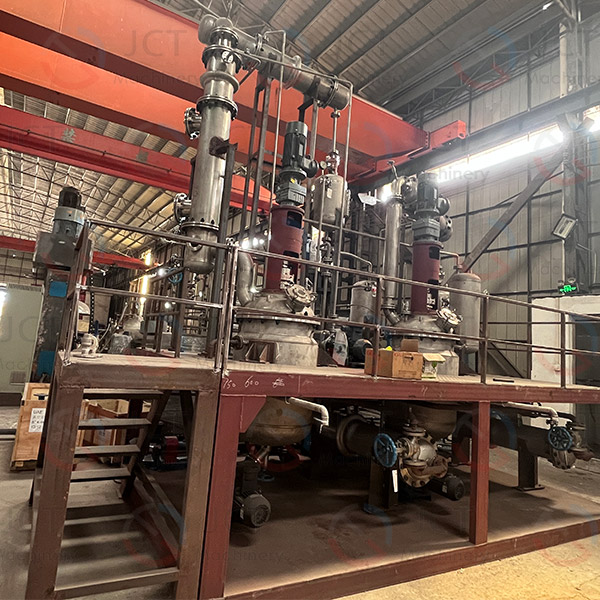
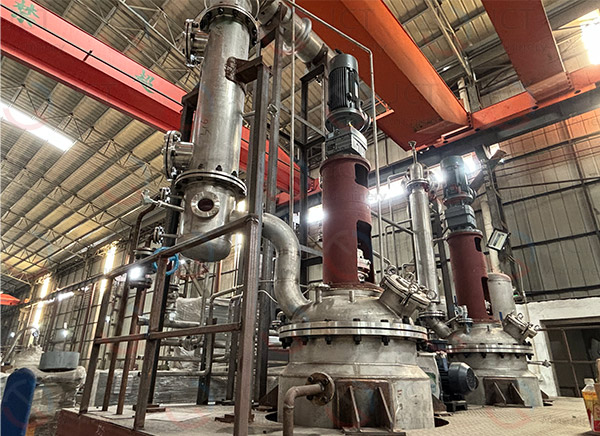
| Polymerization reactor | Jacketed half-pipe heating/cooling. Requires precision variable frequency stirring to prevent explosive agglomeration |
| Drip metering system | Uses a flow meter or load cell in conjunction with a PLC to achieve a constant drip rate |
| Reflux condensation system | Uses a stainless steel tube condenser to prevent monomer evaporation and loss |
| Filtration and filling machine | Bag filters are recommended to prevent breakage of shear-sensitive emulsions |
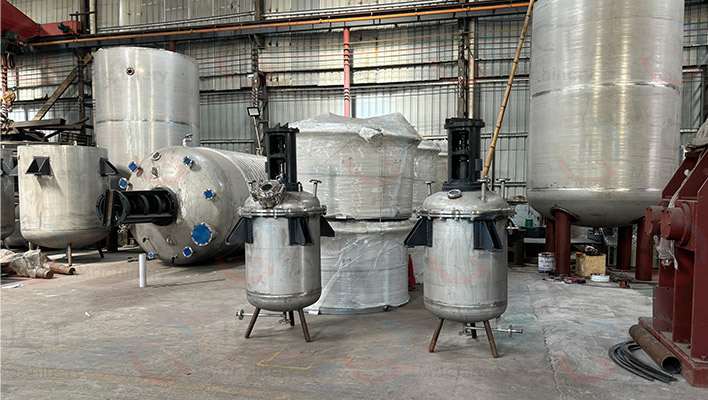
Q: Styrene-acrylic emulsion polymerization reaction is highly exothermic. How can the risk of "explosive polymerization" be avoided?
A: Our styrene-acrylic emulsion production line uses a reactor linkage control syste. Through PLC, the real-time reactor temperature and monomer dripping rate are logically interlocked: once the temperature exceeds the set safety value, the system will automatically shut off the dripping pump and fully open the cooling water valve. This multi-stage control mechanism is facter and more reliable than manual operation.
Q: How can we ensure that the viscosity and solids content of emulsions are completely consistent across different batches?
A: Batch stability depends on the accuracy of the feed. We recommend installing high-precision weighing modules (load cells) at the bottom of the reactor to achieve closed-loop metering. Compared to traditional metering pumps, the weighing method eliminates pressure and bubble interference, ensuring that the monomer to initiator ratio is accurate to the gram level.
Q: Is the production line easy to clean? How can particle (gel) formation be reduced?
A: The inner wall of the reactor is mirror-polished with a Ra<0.4μm finish, greatly reducing material adhesion. We include a 360℃ high-pressure rotating cleaning ball (CIP) as standard. To address the clumping issue, we have installed a bag filter at the discharge end and recommend using a low-shear disphragm pump to prevent emulsion demuldification caused by mechanical shearing.

Donglian Jincheng Industrial Zone, Danzao Town, Nanhai District, Foshan City, Guangdong Province, China

Copyright © 2025 Foshan JCT Machinery Co., Ltd.



 Home
Home


