
 Home
 JCT
 Sep 30,2026

In the field of ink manufacturing—particularly for high-viscosity offset inks, plastic offset inks, gel-like vehicles, and high-concentration pigment masterbatches—sigma mixer is primarily used for the initial wetting of dry powders, high-intensity dispersion, and the kneading of vehicles.
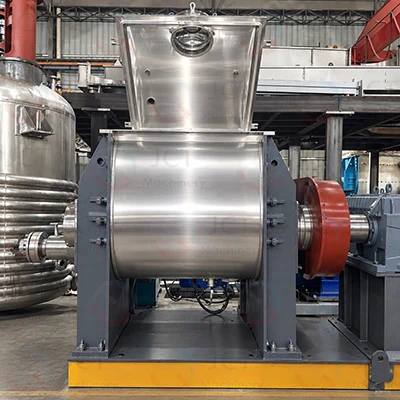
Main Configuration of Sigma Mixer For Ink Production
| Blade Configuration | Σ-type or fishtail-type blades; the two blades rotate in opposite directions at differential speeds (typically a 3:2 ratio), generating intense squeezing, stretching, and shearing effects |
| Materials and Corrosion Protection | SS304/316 is recommended for parts in contact with the material; for applications involving carbon black or inorganic pigment inks that require high wear resistance, the blade surfaces can undergo mirror polishing or be coated with hard chrome or tungsten carbide |
| Temperature Control System | Jacketed heating/cooling (using thermal oil, water, or steam). Moderate heating is required during the pigment wetting stage to reduce viscosity, while cooling is necessary during the kneading stage to dissipate frictional heat generated by high shear |
| Vacuum Degassing | Vacuum sigma mixer (capable of achieving a vacuum level of -0.098 MPa) prevents air bubbles from becoming trapped in the material, which would otherwise impair the refining efficiency of the subsequent three-roll mill and the gloss of the finished ink |
| Discharge Method | Screw extrusion (ideal for high-viscosity inks; allows for direct connection to pelletizing systems or discharge piping), hydraulic tilting, or bottom discharge |
| Explosion-proof Safety | Production lines for solvent-based inks must be equipped with Exd IIBT4 explosion-proof motors, explosion-proof control cabinets, and static grounding devices |
Primary Role of Sigma Mixer in Ink Production
- Efficient pigment wetting: Utilizes high shear forces generated at high viscosity to force the vehicle (resin and solvent) into the micropores of pigment aggregates, displacing air and moisture from the particle surfaces.
- Reduces subsequent three-roll milling time: Pigment aggregates are initially broken down and uniformly dispersed during the kneading stage, significantly reducing the number of passes required in subsequent three-roll or bead milling and substantially boosting overall production line capacity.
- Preparation of high-concentration masterbatches/bases: Used for the "flushing" process—dehydrating and kneading high-concentration pigment cakes (such as filter cakes) with resin vehicles.
Please contact us for more information on configuration options and sigma mixer for ink production pricing.
Tel: +86-181 3837 3963 (Whatsapp, Wechat)
Email: george820606@gmail.com
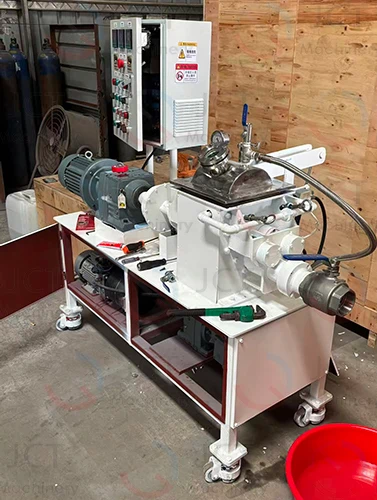
 Dental Resin Vertical Kneader