
 Home
Home JCT
JCT  Jul 03,2026
Against the backdrop of the global chemical industry's dual pursuit of green transformation and high-quality development, coating manufacturers face critical technological choices. As the two pillars of the market, water-based and solvent-based coatings differ in ways that extend far beyond end-product performance; these differences reach deep into industrial manufacturing aspects such as production processes, equipment selection, and overall workshop layout.
Whether you are planning a new water-based or solvent-based paint production line project or upgrading an existing production line, we can provide you with a one-stop, high-standard, customized solution that meets all safety and environmental requirements: +86-181 3837 3963 (Whatsapp, Wechat), george820606@gmail.com.
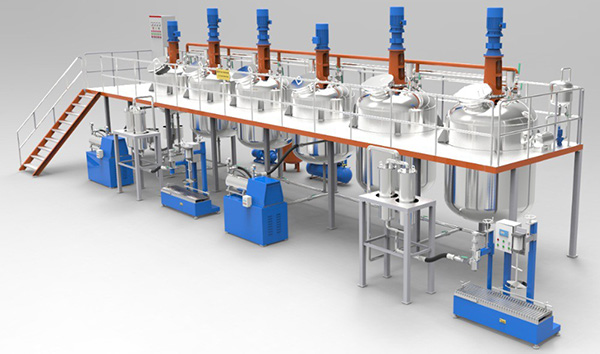
The fundamental difference between water-based and solvent-based coatings lies in the diluent (solvent) systems they employ. This essential distinction determines their vastly different physical and chemical behaviors.
- Water-based coating: These utilize pure water as the primary diluent. Their film-forming substances typically consist of modified acrylics, polyurethanes (PU), or composite emulsion systems based on these materials. Because water serves as the medium during production, the entire system exhibits highly hydrophilic characteristics.
- Solvent-based coating: These employ organic solvents (such as lacquer thinner, turpentine, xylene, etc.) as diluents. Their resin systems encompass nitrocellulose (NC), polyurethane (PU), alkyd, and epoxy, among others. The use of organic solvents imparts unique solubility and volatility characteristics to these coatings.
Environmental Attributes, Workshop Safety, and Fire Safety Compliance
- Water-based coating: These offer significant environmental advantages, characterized by extremely low VOC (Volatile Organic Compound) emissions and a near-total absence of toxicity or pungent odors during production and application. As water is non-flammable, production lines for water-based coatings benefit from high fire safety ratings, and regulatory compliance requirements for storage and production environments are relatively less demanding.
- Solvent-based coating: Due to their high content of volatile organic solvents, these coatings generate significant VOC emissions and emit strong, pungent odors. Crucially, these organic solvents are flammable and explosive. Consequently, production workshops and storage facilities for solvent-based coatings must strictly adhere to high-standard explosion-proof and anti-static design requirements, resulting in relatively higher costs for fire safety compliance and occupational health measures.
Drying and Curing Mechanisms and Process Environment Control
- Water-based coating: These rely on a physical drying mechanism involving water evaporation. The system is extremely sensitive to the temperature and humidity of both the production and application environments. If ambient humidity is too high (e.g., exceeding 85%) or the temperature is too low, water cannot evaporate effectively, making it difficult for the paint film to cure or leading to defects. Consequently, modern applications of water-based coatings often require systems such as hot-air circulation, infrared drying, or constant temperature and humidity control to accelerate the curing process.
- Solvent-based coating: These cure primarily through the natural evaporation of solvents or via chemical cross-linking within the film-forming agents. They are relatively less affected by ambient humidity, resulting in a stable curing rate. While the requirements for workshop temperature and humidity control systems are not as stringent as those for water-based paints, these coatings necessitate the installation of high-efficiency, powerful exhaust ventilation and solvent recovery systems.
System-level Differences at the Manufacturing Industry Level
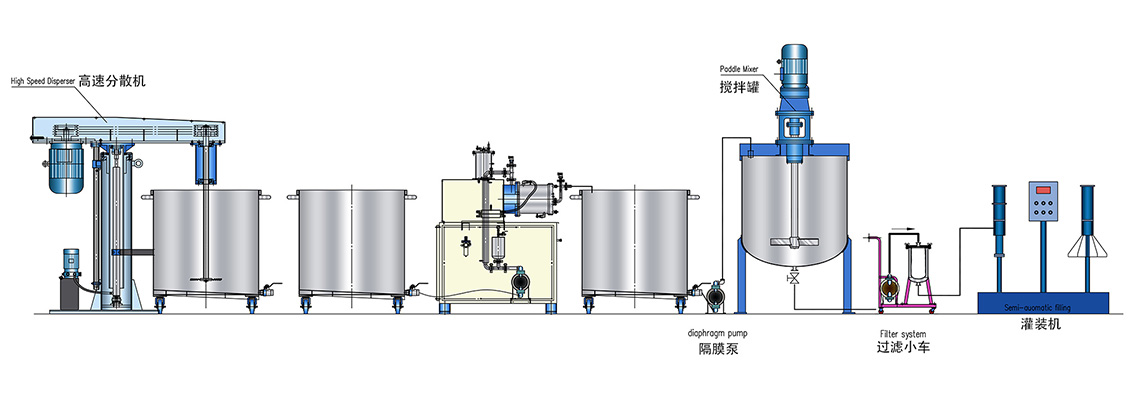
- Strict requirements for corrosion-resistant materials: The high water content in water-based paints means that if production line components come into contact with ordinary carbon steel, rapid rusting occurs, contaminating the coating. Consequently, all equipment in the production line—including reaction vessels, high-shear dispersers, grinding mills, material transfer piping, and even finished-product packaging drums—must be constructed from high-grade stainless steel (such as SUS304 or SUS316L) to ensure robust corrosion and rust resistance. In contrast, since the solvents used in oil-based paints are non-corrosive to metal, material requirements focus primarily on explosion-proof capabilities and pressure resistance.
- Cleaning, color switching, and environmental compliance: Uncured water-based paints are highly water-soluble; therefore, switching colors or cleaning equipment requires only circulating fresh water, resulting in low costs and rapid turnaround. Cleaning oil-based paint systems, however, consumes large quantities of expensive organic solvents, and the resulting waste liquid is classified as hazardous waste, entailing high costs for downstream environmental treatment.
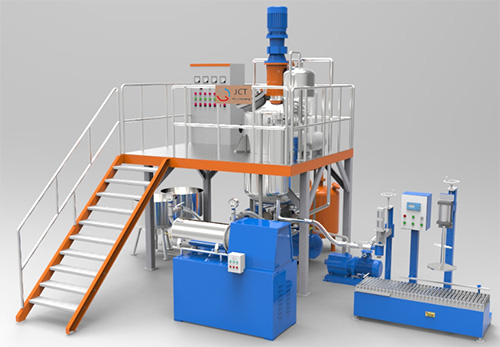
 Polyester Resin Production Line Turnkey Project Help You Achieve Efficient Production Startup